

Today I am brewing one of my favorite styles of beer, a Bavarian Dunkel, a German dark lager. Since my basement stays pretty warm even in the winter, I’ve never made a lager before. But, I recently received a Ss Brewtech Brewbucket and FTSs (Fermentation Temperature Stabilization System) as a gift and thought this would be the perfect time to try it out.
I’ve also decided to try something new. I’ve been brewing for about a year now, but only worked from kits and defined recipes. This recipe doesn’t come from a book or kit, but is instead being built from the ground up. Everything is an experiment, and relies heavily on the guidance of more experienced brewers than myself. I realized I have a lot to learn.
So here we go! Let’s embark on the first ever experiment in the Brew Lab! I hope I don’t screw it up (let’s be honest, I’ll probably screw it up.)
What I’m Drinking
What’s a good brewing session without a cold beer in hand?
Tonight I am drinking a Kansas City Bier Company Dunkel – the inspiration for tonight’s brew.

KC Bier Co. was one of the first in a wave of new microbreweries that sprung up in the Kansas City area just in the last 4-5 years. They began as a brewhouse and biergarten serving traditional German styles, and eventually began kegging 2 years ago and bottling for wide distribution last year. Now, you can’t go to any bar in Kansas City without seeing a bright red KC Bier Co. tap handle and the bottles are available in every liquor store.
Dunkel is KC Bier Co.’s most popular brew, and my personal favorite. It’s a traditional German dark lager (Dunkel means dark in German.) It’s got great bready malt flavors that are balanced by a little bit of bitterness. It’s also incredibly easy drinking, leaving you satisfied after one with dinner but light enough to drink session-style.
The Ingredients
So I have a confession: I have no idea what I’m doing. I went to one of my local brew shops, Bacchus and Barleycorn with the intent of picking up one of their specialty brew kits and happily continuing my day, but they didn’t have one. So I thought, why not just try and make a kit on my own?
Well, it’s a lot harder than it seems.
Thank goodness they had a master home brewer there to walk me through the whole process. She helped me calculate how much LME (liquid malt extract) I should buy, how much specialty malt I’d need, and helped me find hops and yeast. Honestly, this recipe is hers, I’m just following along for the ride.
So here are the ingredients I’m using for this brew:
1 – 3.3 lb. can of Briess CBW Munich LME
1 – 3.3 lb. can of Briess CBW Pilsen Light LME
1 – lb. Dark Munich Malts
1/4 lb. Caramel C35 Malts
(These two were combined in store)
1/4 lb. CARAFA III malts
1 oz. Hallertauer Mittelfruh hop pellets (2.5 AAUs)
1 oz. Tettnanger hop pellets (2.0 AAUs)
1 oz. Hallertauer Hersbruker hop pellets (1.4 AAUs)
2 – Wyeast Munich Lager
Irish Moss
Priming Sugar
The Plan
I have built out the entire Bavarian Dunkel recipe on Brewers Friend and you can download the recipe sheet here: Dunkel – Basement Brewing Lab Recipe.
Step One: Cold Steep

I actually began the brew the night before when I took the milled CARAFA III malts and put them in a small measuring glass with 1 qt of cold water, then covered and put in the fridge overnight. Once I get a better idea of how to do this, I will write a blog post about it, but in the mean time you can learn more about cold steeping here.
Step Two: Prep the Yeast
I kept the two packages of yeast in my mini fridge at work until shortly after lunch, then smacked them to begin prepping the yeast shortly after lunch. Usually I only do this a couple to 3 hours before the brew, but my research suggested I start early with lager yeasts.
Step Three: Sanitize Supplies
I always default to make 4 gallons of One-Step sanitizer for this step, which tonight felt a bit like overkill. Oh well. Here are the supplies you need to prep.
1 Your brew kettle and lid (6-10 gallons)
1 Second Large Pot (You won’t be boiling anything, but just need enough room to store 1-2 gallons and keep it somewhat warm for 5-10 minutes)
1 Large bowl and strainer (Just need somewhere to strain the grain bag and pour water over it and collect the water after. If you have a straining set up for your brew pot, not as necessary)
Long handled brewing Spoon
Mash Paddle
Spoon
Thermometer
Necessary transport equipment (Moving from kettle to fermenter)
Step Four: Mini-Mash
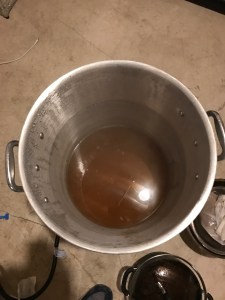
This technique was all new to me. Most of the part liquid malt / part specialty malt kits I had worked with had just told me to steep the bag of specialty malts at a boil for 30 minutes. My friend/guardian angel at Bacchus and Barleycorn suggested I try this with the blend of specialty malts I was planning to use. She called it a Mini-mash or partial mash.
I couldn’t find an exact time for the length of the steep as it varies depending on how much specialty malt you’re using, but these were the instructions I received. Again, I’ll look more into this and write a full post eventually on the technique but right now I’m just writing what I was told.
First heat 1-1.5 gallons of water to 158 degrees. Remove from heat.
Add specialty grans in a tied nylon steeping bag and slosh around to saturate grains. Cover. Let sit for 5 minutes.
After 5 minutes, check temperature. It should be around 152 degrees. Keep between 150 and 152 for 30 minutes by putting on the heat or removing and constantly checking the temperature.
Remove the grain bag and let drain into the wort. Now remove the wart and place in the second 2 gallon pot and cover. You should place the bag in the strainer over a large bowl to allow continue dripping.
Heat another 1-1.5 gallons of water to 180 degrees. Remove from heat.
Place in grain bag. Slosh around to saturate the grains again. Let sit for 5-15 minutes.
Take extra drippings in the large bowl and add to the wort in the 2nd large pot.
Remove grain bag and allow to drip.
Once you’re done add the 1-2 gallons of wort from the previous boil to the main brew kettle. Now it’s time to start the main boil!
Step Five: Boil
Bring the 2-4 gallons of wort from the mini mash to a boil in your brew kettle.
Once the wort is boiling, add the two jars of LME. Stir and continue to bring back up to a rolling boil.
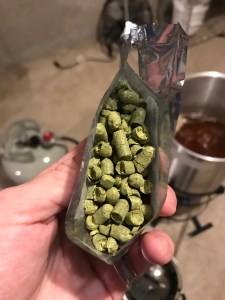
Add the Tettnanger and Hallertauer Mittelfruh hop pellets. Boil for 45 minutes, stirring to avoid boil over.
While the wort is boiling, pour the cold-steeped CARAFA malt liquid over a coffee strainer or malt bag into a cup or collection dish. The remaining liquid will be added to the boil later.
After 45 minutes, add the Hallertauer Hersbruker hop pellets and the strained CARAFA malt liquid and stir. Continue to boil for 15 more minutes.
Once the boil is complete, quickly chill the wort to 60 degrees using an ice bath or wort chiller (I used a combination of both)
Pour approximately 1 gallon of fresh cold water into your fermenter. Once the wort reaches 60 degrees, add the wort and aerate. Add water to reach 4.5 – 5 gallons total.
Check the gravity. Ideally it will be between 1.044 – 1.056. Mine was 1.055.
Sanitize both yeast packs and add them. Seal up the fermenter and you’re good to go!
Step Six: Fermentation

I am using the Ss Brewtech BrewBucket and FTSs. I have set the system on 55 degrees and added a ton of ice to my cooler. It’s my first time using this awesome system, let’s see how it works!
Update #1 – 10 hours
Fermentation has begun somewhere between 5 and 10 hours. Bubbling is slow as of now, but seems to be speeding up. The first bag of ice has melted, but the water in the cooler is still cool and temperature has been maintained.
Update #2 – 52 hours
Fermentation is furious now. In fact, the airlock has bubbled and lost some of the liquid. I’ve added a little more sanitizer to keep the air sealed. It’s becoming a little difficult to keep the temperature around 55. I’ve realized my ice maker can’t keep up, so I ordered a bunch of reusable ice packs on Amazon Prime rather than buying more ice from the gas station. This is probably a great solution moving forward to save a bit of money.
Update #3 – 1 Week
I’ve found it a little difficult to keep this fermentation temperature down low enough, but the system is working like a charm. I can’t tell if I don’t have a cooler efficient enough to keep the ice cool or the FTSs system itself isn’t efficient. We’ll see. Looks like my system of exchanging ice packs 3 times a day is working well enough.
Bottling
I tested my gravity 3 weeks after brew day and we reached a nice 1.014 – my target finishing gravity. It’s time to bottle!
Tasting
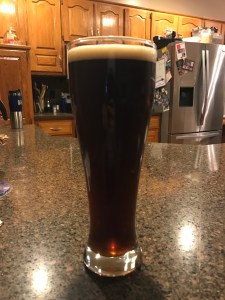
This is without a doubt the best brew I’ve made thus far. It has a nice orange head with a brilliant dark color. It smells biscuity and finishes with a sweet chocolaty flavor from the CARAFA malts. It’s awesome, and easy to drink!
That being said, after bringing a few bottles to my local brewing society meetings, I’ve realized the flavor of my Dunkel is a bit fleeting. It needs quite a bit more body. Oh well, Keep an eye out for Version 2!
 FINAL ASCENT BREWING